


Article: What the coffee left behind
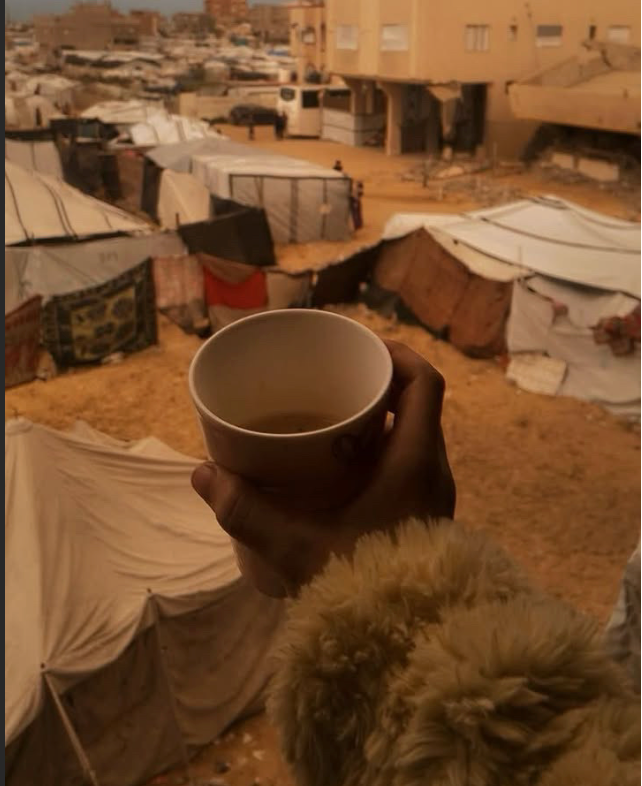
What the coffee left behind
Nouran is a dear friend of mine. She is a bright young woman living in Gaza, and I’ve had the privilege of talking with her almost weekly for more than 2 years now.
We often talk about her life and how everything was like before October 7th, how everything is now, but also about normal things like her family, her studies, my kids, and coffee.
I rencently asked her:
‘’What place does coffee hold in everyday life in Gaza?’’.
This is the story she wanted to share with the world. - David
It tastes like burnt paper. Bitterer than life itself here in Gaza, somehow, and that’s saying something. But you drink it anyway, it’s your only small proof that you can still move through an unstable life, that you can still hold on to whatever power you have left, that you can still get through displacement, and loss, and indignity, one cup at a time. That is what coffee is now. It was not always this.

Before, we had a warm house where the smell of cardamom in the boiled coffee curled into the smell of incense my mother burned beside it, every morning before seven, where my father poured it unasked the moment a guest walked in, take one breath, and say nothing but “Allah”: that single word Gazans use when a smell is so good it stops you mid-sentence, half prayer and half pure pleasure. Fridays were when the house was loudest: family gathered in the sitting room, neighbours and cousins, small cups passed hand to hand, the sound of a house that was never really empty. Coffee announced, every single morning, that everyone was home.
Every household trusts coffee called Mazaj from Badri & Hania, a small shop that opened in 1979 inside Zawya Market, at the heart of Gaza’s Old City, then it became the most popular coffee shop in the whole city, until Israel destroyed it. Mazaj coffee sits in every kitchen cabinet the way flour or salt did, it had always been there. Coffee here had become a symbol of something greater than life itself, under occupation and siege. Coffee, as it is prepared in the Turkish style, has long been a central part of Gaza's culture.
The last time my whole family sat together like that, was Friday morning, October 6th, 2023. We made what we called a “mood coffee”. I remember that morning well, we sat together with my father, under the olive tree in our backyard, coffee in hand, talking about how the week just past had gone and what we’d do with the one about to start.
The next day, everything changed, quietly at first and then all at once. The genocide began. The crossings closed. My family was separated. Our home was destroyed. We were displaced under fire, more than once. Even then, in those first months, under blackouts and the earliest shortages, the smell of ground coffee still drifted through alleys and tents. It's one of the last ordinary things people refused to give up before there was nothing left to hold onto. We lived in a tent in Rafah, where I sat in the street and a cup of coffee in my hand to catch enough signal to attend an online lecture. We moved again after that, to Deir al-Balah, where the only internet came from makeshift points built out of tarp and wood, where I spent daylight hours sitting under them in the heat just to keep a device charged long enough to finish a project or sit an exam, while the power cut in and out with no warning at all. Meanwhile,one by one, ordinary things vanished from the shelves like flour, sugar, and cooking gas. Their prices climbed in ways that made no sense, Salt price rose 195%, sugar up 170%, flour up 85%, in a single month - according to Palestinian Central Bureau of Statistics data - until coffee disappeared too. There was simply none to be found, not in the markets, not through relatives. Within months, the cafés that used to carry that same familiar smell were gone too.
By June 2024, the numbers had a name for what we were living through: the UN’s Integrated Food Security Phase Classification found 96% of Gaza’s population - about 2.15 million people - facing high levels of acute food insecurity, nearly half a million of them already in the most catastrophic phase the system measures. A year later, in August 2025, the same body confirmed something worse: famine, formally, in Gaza Governorate, more than half a million people facing conditions statisticians don’t classify lightly.
When real coffee beans became almost impossible to find, people started roasting and grinding whatever they had instead, like lentils and chickpeas and it sold at prices absurdly high for something that wasn’t even coffee. There was nothing else we could do, so we bought it anyway. The first time I tried it, the bitterness had nothing to do with coffee’s bitterness. It was burnt, closer to colocynth, and it sat badly in my stomach afterward.

Saeb Shaheen, a coffee seller who kept selling through his own displacement from Jabalia camp, described how it's done: “We roast lentils over a fire until they turn a brown color similar to that of roasted coffee. Then we grind the roasted lentils by hand in the wooden hand-crank called al-houn, until they become a fine powder resembling coffee. We add whatever other seasonings are available, such as cardamom or cloves, to enhance the flavor.” He watched the price of a kilo climb far beyond reason: “A kilo went from 40 shekels [$12] to 100 dollars, and now it's reached 2,000 shekels per kilo,” he says. “I still try to sell, but I have to mix beans with chickpeas, lentils and cardamom to make it stretch. We sell that mix for 800 shekels. It's not real coffee, but what can we do?”. A woman named Hanan Alshaer, from Al Shati refugee camp, described the same shortage, “Coffee lifts your mood. It calms your nerves. It's how we cope with life here. When that was taken from us, it felt like a part of us was gone.” she said it more plainly than I ever could: taking coffee away from someone in Gaza, she said, takes away a piece of their resilience. I understood exactly what she meant the moment I heard it, it never had been about the drink, we considered that coffee is a symbol of something greater than life.

while the genocide and the siege forced me to try the new version for my love “the coffee”, I was forced to drink that cup to keep going and continue my education, to keep building the VR project I’d been working on. My cup of coffee became the one thing, besides my laptop, that I carried with me everywhere. It reminded me of home. It gave me the power and the inspiration to keep learning, to keep working, to keep building a VR therapeutic environment for children with PTSD, at exactly the moment I needed that same kind of support myself. My team and I finished it, and it won Best Graduation Project at UCAS Gaza. I think I was doing, without fully realizing it, trying to rebuild something I missed badly. A home. Placing a tree where a tree should be, a color where a certain light used to fall, a quiet space shaped like the ones we used to have. I was reaching for the architecture of a place that was disappearing in real time more than designing scenes for children.

When something as small as coffee becomes unreachable, it tells you the siege was never only about military equipment. It was about everything that gave our life meaning, even the smallest things. The olive trees are gone now too, completely erased the same way the house behind them was erased. That is what occupation does to a place. It takes the shade you sat in. It takes the exact spot where the coffee used to be poured.
Every single detail of my life has changed. Nothing returned, and nothing will. Our house was destroyed. Our Fridays are not the same, and that gathering will never come back. My father went missing. I lost so many friends and family that I lost their voices too, one by one, along with the coffee-mood mornings I used to share with them. The feeling of home will never return exactly as it was. I will notice all of it, always, the way you notice anything you were forced to learn you could lose. . Until then, we keep pouring what we have, because the pouring itself is a way of refusing to let go of what we were. But the voice in my head keeps asking, when will we have a normal day again?

